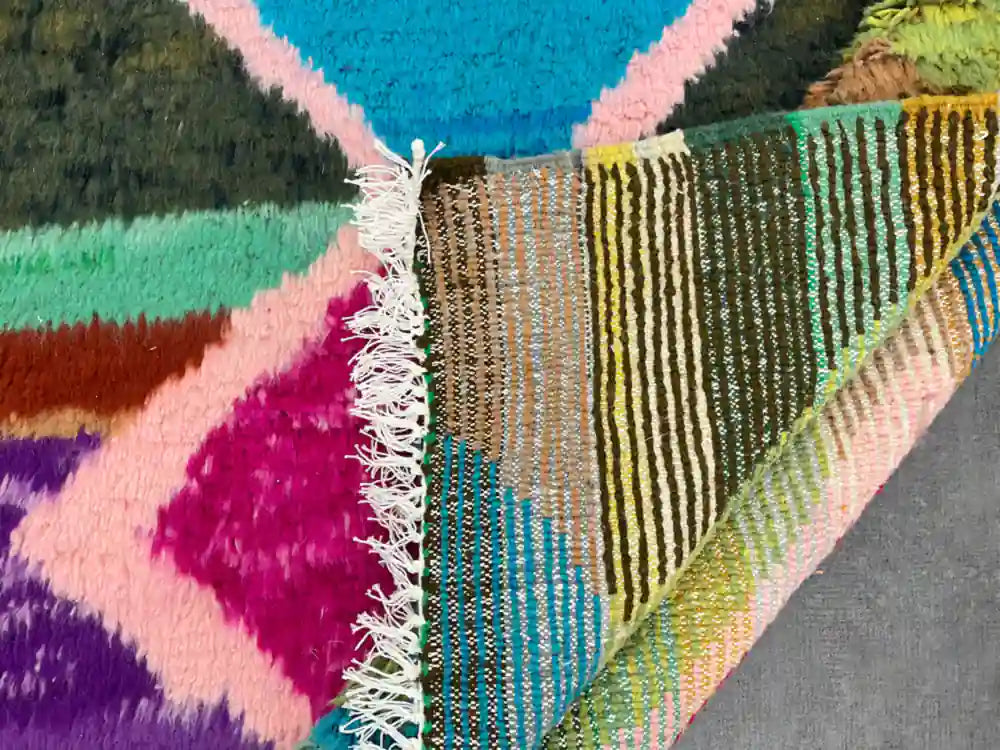
Colorful Azilal rug handmade in natural wool
Colorful Azilal rug handmade in natural wool
- Free delivery
- Free exchange or refund
- Rated 5/5 on Google Reviews
Couldn't load pickup availability
• Type: Colorful Azilal Rug
• Origin: Middle Atlas Mountains, Morocco
• Manufacturing: Handwoven using ancestral techniques
• Material: 100% natural sheep's wool
• Dimensions: 250 x 159 cm (excluding fringe)
• Condition: New – unique item
• Year: 2026
• Reference: TAP 753
A colorful Azilal rug: boldness, heritage and softness in a single object
The colorful Azilal rug is a true textile masterpiece, handwoven in the heart of Morocco's Middle Atlas Mountains. It reflects the expressiveness of Berber artisans, who blend contemporary creativity with traditional symbolism in every thread. This rug is distinguished by its untreated natural wool, its soft feel, and its vibrant patterns. It embodies a living craft, where every detail tells a story. Its pure sheep's wool composition guarantees thermal comfort, durability, and exceptional softness underfoot, even with daily use.
Thanks to its ecru background and multicolored contrasts – blue, pink, purple, yellow, or black – this rug structures the space while brightening it. It becomes a centerpiece of your interior design. In a minimalist living room, a bohemian bedroom, or a creative office, the Azilal rug infuses a joyful and welcoming atmosphere. By choosing this model, you not only introduce an artistic touch to your interior, but you also contribute to preserving an ancestral heritage. Discover all our Azilal models here .
Berber authenticity at the heart of a vibrant design
Each Moroccan rugs are handcrafted by women weavers in villages of the Middle Atlas Mountains. They work for several weeks on traditional looms. Each motif is conceived and knotted without a preliminary sketch, allowing for complete creative freedom. It is this spontaneity that makes these rugs so unique. No two designs are ever exactly alike. The weaving process blends natural sheep's wool with natural dyes, resulting in a vibrant and environmentally friendly product.
The geometric patterns, broken lines, and diamonds found on the colorful Azilal rug are not merely decorative. They symbolize femininity, nature, fertility, and protection. These symbols have been passed down orally for generations. Each rug thus becomes a reflection of collective memory and precious craftsmanship. You can learn more about Berber rug styles in our dedicated blog post .
A decorative but also functional piece
Far from being reserved for museum interiors, the Berber rug is perfectly suited for everyday use. It can be placed in a high-traffic living room, a child's bedroom, or a cozy office. Its dense wool is highly resistant to wear and tear, doesn't flatten, and retains its shape. It is also compatible with underfloor heating, as the wool allows warm air to circulate without trapping it. It is therefore a comfortable choice in both winter and summer.
For maintenance, simply vacuum it once a week without a rotating brush, or shake it out outdoors. Every two years, professional cleaning is recommended to regenerate the wool fibers. This light care is enough to maintain its luster, loft, and thermal properties. You will find our care tips directly on the BERB website , so you can effortlessly extend the life of your rug.
Buying a colorful Azilal rug: a committed and ethical choice
Choosing a colorful Azilal rug means choosing a living craft, far removed from industrial production. At BERB , we work directly with Moroccan weavers and pay each piece a fair price. We support ethical trade that respects local culture and natural resources. Every purchase helps preserve traditional techniques and strengthen the economic independence of women artisans.
Furthermore, our approach prioritizes transparency: you receive a unique, handwoven rug, photographed exactly as it is, without retouching. This allows you to see every knot, every irregularity that contributes to the richness of handcrafted work. This level of quality far surpasses that of mass-produced rugs. To learn more about Berber rugs in general, you can also consult the Wikipedia article dedicated to this exceptional textile heritage.